
The Strategic CSM Has Always Been the Goal. AI Removes the Barrier.
For as long as Customer Success has existed, its vision has been remarkably consistent. We’ve wanted Customer Success Managers to be trusted advisors, not just product experts. Strategic partners, not just relationship managers. Business consultants, not just problem solvers.
In other words, the strategic CSM has always been the goal. So why has that vision remained so difficult to achieve? The answer wasn’t a lack of ambition. It wasn’t a lack of training. And it certainly wasn’t because Customer Success leaders didn’t understand the value of strategic account management.
The barrier has always been the work.

The Reality of Customer Success
Despite the industry’s aspirations, many CSMs have spent their days in reactive mode.
Responding to escalations. Coordinating internal teams. Preparing QBRs. Updating CRM records. Chasing stakeholders. Analyzing product usage. Following up on action items. Managing renewals. Putting out fires.
Every one of those activities matters. But together, they consume the time and mental bandwidth required for the work that creates the greatest long-term value: understanding a customer’s business strategy, building executive relationships, identifying emerging opportunities, and helping customers achieve measurable outcomes.
For years, Customer Success leaders have invested in playbooks, methodologies, and operating models designed to make their teams more proactive. But operational demands kept pulling CSMs back into reactive mode.
It wasn’t a failure of vision. It was a capacity problem.
AI Changes the Equation
This is why AI is such an important inflection point for Customer Success organizations. Not because it changes what the CSM role should be, but because it finally makes that vision attainable. By taking on the tactical work that used to consume so much of the CSM’s day, AI makes a new operating model possible. It creates space for better preparation, sharper insight, deeper account planning, and more meaningful customer conversations. It creates room for the CSM to move from reacting to guiding.
That’s the opportunity. The barrier is coming down.
Now the question is what leaders do with the space that opens up.
What CS Leaders Should Do Now
If AI is removing the barrier, the next step is to make sure Customer Success teams are ready to maximize the value of the opportunity. That starts with the following:
First, leaders need to define the split in work between AI and CSMs. If that line is unclear, the team will either keep doing work AI should handle or give away work that still requires human judgment. The goal is a clear vision of what AI owns and what the CSM owns.
Second, leaders need an operational plan for both sides. A modern CS motion does not happen by accident. It requires a plan for how AI will be integrated and enabled, and a separate plan for how CSMs will operate inside that new model. Clear workflows, expectations, handoffs, and rhythms matter for both.
Third, they need to identify the skills gap. If the role is evolving, the team has to evolve with it. Leaders need a plan for where CSMs need to grow, how they’ll be supported, and what capabilities matter most in the next version of the role.
That is the real work now: not just removing friction, but building the conditions for the team to succeed.
Designing for Modern CS
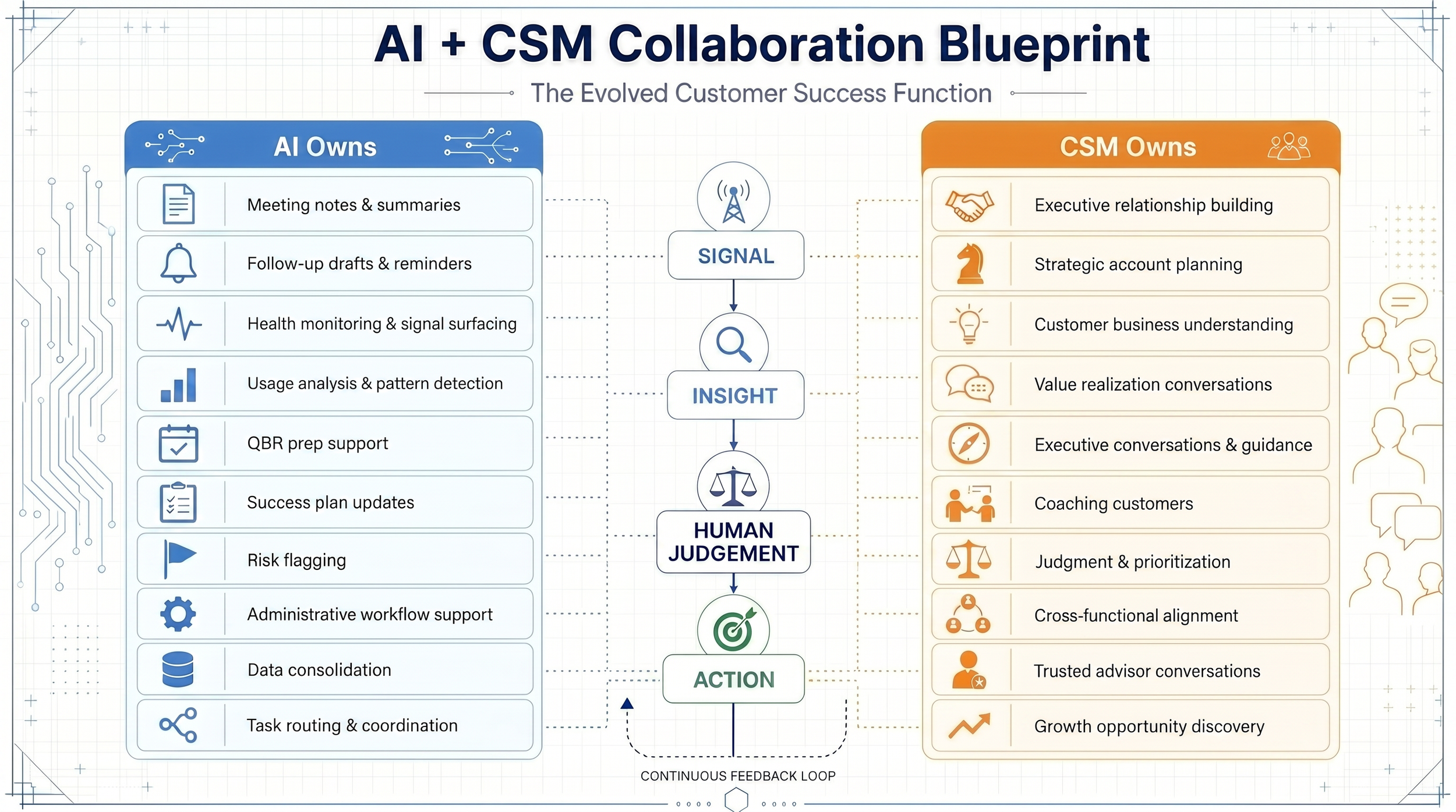
The best companies are already doing this by design. They are rethinking how Customer Success is structured so that CSM time goes where it matters most. They are creating clearer ownership across onboarding, adoption, renewals, and expansion. They are building repeatable motions so the team is not improvising every account from scratch. And they are aligning managers around coaching, not just coverage.
That is what makes the shift real. Because modern Customer Success does not come from asking people to “be more strategic.” It comes from building a system that supports strategic work.
It also comes from giving people the support they need to grow into the role. A CSM cannot be expected to operate differently without clear expectations, strong enablement, and a path to develop the right skills. If the destination has changed, the journey has to change too.
Enabling CSMs to Succeed
This is where CS leaders matter most.
The leader’s job in this moment is to create the conditions for the team to succeed. That means defining what great looks like, coaching managers to reinforce the right behaviors, and making sure the structure around the team supports the kind of work the organization now wants CSMs to do.
This is not about asking CSMs to do more. It is about helping them do more of the right work. It is also about recognizing that the strategic CSM is not just a title. It is a capability. And capabilities have to be built: through training, through process, through coaching, and through a clear maturity plan that helps the team move from where it is today to where it needs to be.
That is the opportunity AI creates. Not just efficiency, but evolution.
The Promise of Customer Success
I don’t believe AI is redefining Customer Success. I believe it is accelerating its original promise.
Customer Success has always pointed toward the same end state: proactive CSMs who help customers navigate change, achieve business outcomes, and uncover new opportunities for growth. The challenge has never been the destination. It has been the operational reality that left too little time to get there.
AI removes one of the biggest barriers that has historically kept Customer Success from becoming the strategic function it has always aspired to be. The destination hasn’t changed.
For the first time, the path to getting there is becoming real.